
Prove the one assumption that could sink your build, before you spend the budget
A proof of concept is a small, time-boxed piece of throwaway code, commissioned to test the single riskiest assumption behind a proposed build before you commit the full budget. Its job is to return a clear go or no-go answer to the one question that could sink the project, cheaply enough that a "no" is still money well spent.
In software, "PoC" means exactly this: not a point of contact, and not the security sense of a proof of concept that demonstrates an exploit. Some vendors label the same exercise a Proof of Value, or PoV. Either way, the code exists to prove technical feasibility on the riskiest point, then it is discarded.
That points to a reframe worth keeping. You are buying a decision, not an app. Before you commission anything, discovery scopes the real problem; a proof of concept then buys the answer to the one question that decides whether the full build is worth funding.
The reframe: a proof of concept is a purchase you make to answer a question, not a product you receive.
What a Proof of Concept Is Really There to Prove
The natural instinct, when you commission one, is to ask it to test whether the idea works. That instinct quietly overloads the exercise. A proof of concept cannot sensibly test a whole idea, and it should not try. It exists to attack a single point: the riskiest technical assumption, the one unknown the entire project depends on and the thing most likely to fail.
The discipline: a proof of concept should spend its entire budget attacking the one assumption most likely to fail, and defer everything you already trust.
The discipline that makes this work is subtraction. Everything you are already confident can be built (the screens, the reports, the login, the workflow) is deliberately set aside. None of it is proven here, because none of it is in doubt. The small budget goes entirely on the part that could sink the build, and nothing else earns a line of code.
A common shape makes this concrete. Picture a system whose whole value depends on pulling clean, reliable data out of a twenty-year-old ERP or line-of-business database. If that integration cannot be made to work, no amount of polished dashboard sitting on top of it matters. So you prove the integration first, against real records, and ignore the parts you already know how to build.
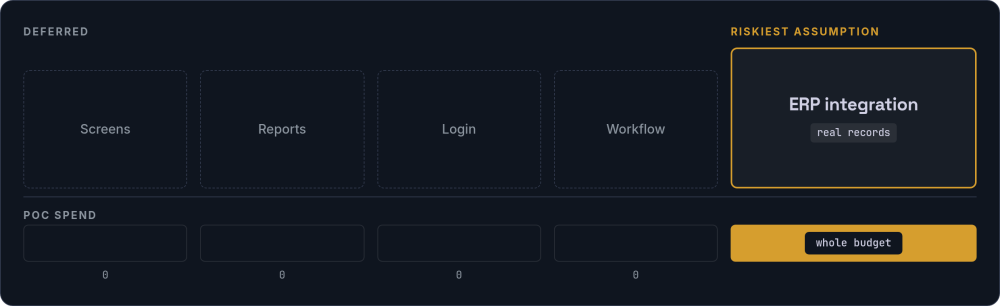
That riskiest assumption tends to take one of four shapes: a hard third-party or legacy integration, an unproven algorithm, an approach that only counts if it holds up on your actual messy data (calling the OpenAI or Anthropic Claude API to check whether the clever bit genuinely works on your records, for instance), or behaviour under real volume rather than a tidy demo dataset. Name which one you are facing, and the proof of concept writes its own brief.
Proof of Concept vs Prototype vs Minimum Viable Product
These three terms get used interchangeably, sometimes by the same vendor in the same meeting, and the mix-up costs real money in misdirected budget. The proof of concept vs prototype confusion is the one that trips owners up most, because both arrive early and both look like a rough first version of the thing. The cleaner way to separate all three is not by where they sit in a build schedule but by the question each one answers for you as the buyer. A prior question usually sits above them all, which is whether to build at all or buy something off the shelf. Once you have decided to build, the three diverge sharply.
| Approach | The question it answers | What you actually get | When it is the right spend |
|---|---|---|---|
| Proof of concept | Can this be done | Throwaway code that exercises only the risky part, proving the hard technical assumption holds before you commit the full budget | You have genuine technical uncertainty and need to know feasibility first |
| Prototype | What will it look and feel like | A clickable mock of the interface and flow, built in a tool like Figma, with no working engine underneath. A Wizard of Oz version fakes the backend with a person behind the curtain to test the experience | You want to test how it feels, or secure sign-off, before anyone writes real code |
| Minimum viable product | Is this a real product people will use and pay for | The smallest genuinely usable version, an idea associated with Eric Ries and Lean Startup, shipped to actual users | You are confident it works and are ready to put it in front of paying customers |
Where the doubt is genuinely technical, whether the hard part can be made to work at all, a proof of concept is the right first spend. Knowing when to insist on one, and when to skip it entirely, is the next thing to settle.
When to Insist on a Proof of Concept, and When to Skip It
The bias in this trade runs one way. An agency profits from selling a validation phase, so the reflex is to recommend one whatever you are building. Paying for a proof of concept on well-trodden, solved software is waste, and an agency worth hiring will say so rather than bill you for reassurance the work does not need. The test is where the risk actually sits: the more the whole build's success hangs on one thing nobody has proven yet, the more a proof of concept is worth insisting on before you commit budget. Occasionally the question points further back, to whether the right call is not to build the thing at all.
The dividing line is feasibility. Once the parts are known to work, the only real questions are time and money, and a different set of signals applies.
What a Proof of Concept Should Cost, and the Quote That Has Drifted
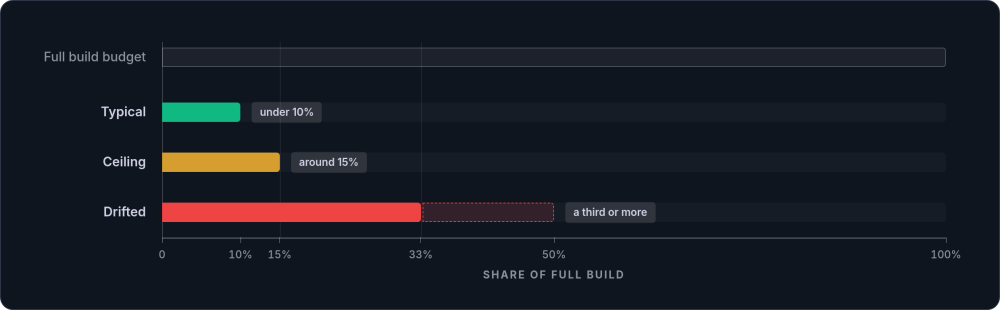
A proof of concept is small by design, and its price should reflect that. Expressed as a proportion of the full build, it usually sits in the single digits to low double digits: often under 10 per cent, rarely more than around 15. In effort, that is days to weeks, never an open-ended stretch of billing. It should reach you as a capped fixed fee, an agreed price for an agreed question, settled up front. Time-and-materials defeats the purpose here, because the whole point of the exercise is to cap your exposure before the large commitment, not to start a meter running.
When the quote has drifted, the number gives it away. If a proof of concept is priced at a third, a half, or more of the whole project, its scope has slid from attacking one risk to quietly building the product. That is an unbudgeted first phase of the build wearing a de-risking label, and it strips out the cheap-failure protection you were paying for.
One question keeps a vendor honest: what single question does this prove, and why does answering it take this much. A crisp answer is a good sign. A vague or sprawling one means the scope has wandered. For where the full costing conversation lives, see the full picture of what a bespoke build costs.
The red flag: when a proof of concept costs a third or more of the whole project, it has stopped de-risking the build and quietly become the first, unbudgeted phase of it.
What You Receive: Working Code and a Written Go or No-Go
A proof of concept leaves you holding two things, and only two. The first is working code that answers a single question: it runs the risky part and shows whether it holds, or it shows the wall you would have hit at full budget. This is not a polished app and it is not something to ship. The second is a short written recommendation, a plain go or no-go, that reads the code back to you in language you can act on.
-
The recommendation A clear go or no-go, stated in one line before any of the reasoning.
-
The evidence What the code actually did, where it strained, and the numbers or behaviour that back the call.
-
The pre-agreed success and kill criteria The line drawn before the work began, so the verdict is measured against it rather than against hindsight.
-
A rough full-build steer On a go, a first sketch of what the complete application would then involve.
The criteria are what settle the argument, and you sign them off before a line of code is written, so the vendor is measuring its work against a line you drew, not marking its own homework after the fact. On a go, that steer feeds straight into how the full application gets scoped and built. On a no-go, the harder discipline applies. Having already paid, the sunk cost fallacy pulls you towards pressing on regardless, and the point of the exercise is to let a genuine no-go stop the project there.
A no-go is a win: a verdict that stops a doomed build before you commit the full budget has done precisely what you paid it to do.
Time-Boxed, Happy-Path Only, and Built to Be Thrown Away
A proof of concept stays cheap because it runs on a fixed clock. The work is scoped as a technical spike, a term borrowed from the Spike Solution in Kent Beck's Extreme Programming: a short, deliberately rough experiment that answers a technical question and nothing else. When the clock runs out, the spike ends in whatever state it has reached.
A spike: a short, throwaway build with one job, to answer the technical question that decides whether the real project is worth starting.
It touches only the happy path, the single straight-line case where everything goes right. Security, error handling, edge cases, and polish all wait, because none of them bear on the one question. Discarding the code afterwards feels wasteful, but you were never buying code to keep. You were buying an answer, and stripping out everything that does not produce it is what keeps the spike fast and cheap. When the question suits them, rapid-build tools like Bubble or Retool reach that answer sooner still.
Four Kinds of Technical Risk Worth Proving First
The riskiest assumption you identified earlier rarely stays abstract. In software it tends to take one of four recognisable shapes, and putting a name to yours is what turns a vague worry into a test you can actually run. Each shape answers a different question, so read them and see which one fits the build in front of you.
Integration risk
Getting clean, reliable data in and out of a system you do not control, such as a legacy ERP, a third-party API with poor documentation, or an old accounting package. The question it answers: will the two systems actually talk to each other.
Performance at scale
Checking it still works when the data or the traffic is real-sized rather than a tidy demo. The question it answers: does it hold up at ten thousand or ten million records, or under real concurrent users.
Data feasibility
Confirming the data you hold is good enough, complete enough and consistent enough to do what you want, usually via a Jupyter Notebook spike over a sample of real records. The question it answers: is the data fit for the purpose.
Novel or AI feasibility
Testing whether the clever or unproven method works on your real inputs, whether that is an AI model called through the OpenAI or Anthropic Claude API or a matching or pricing algorithm. The question it answers: does the clever bit produce trustworthy results on your data.
Where a Proof of Concept Sits, and How It Quietly Goes Wrong
A proof of concept is an optional gate, not a mandatory stage every build passes through. Before it comes discovery, which scopes the real problem and tells you whether a technical risk worth retiring even exists. After it comes a minimum viable product or the full build, once the unknown is settled. You reach for a proof of concept only when there is genuine doubt the thing can be built at all.
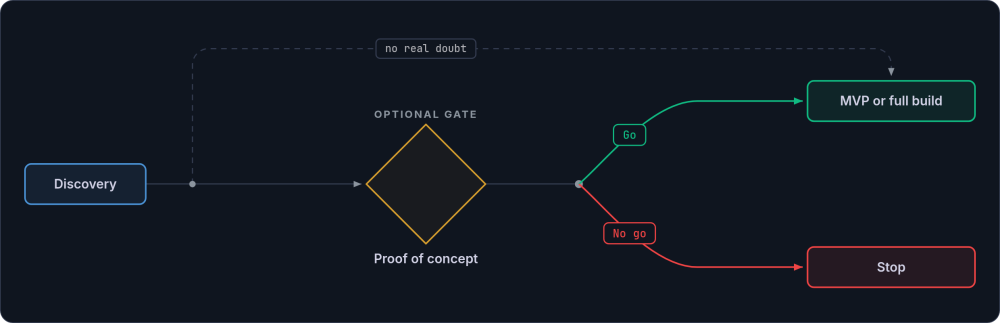
The trap: the most expensive proof of concept is the one that quietly becomes your live system because it "already works". The throwaway code was written happy-path only, with no security and no error handling, and every corner it deliberately cut is now a fault in software you depend on. Two smaller failures sit alongside it: gold-plating the proof past its one question, and proving the part you were never worried about while the real risk goes untested.
A Cheap Way to Protect an Expensive Decision
A proof of concept is a cheap way to protect an expensive decision. It spends a little to interrogate the one assumption that could sink the build, before the full budget is committed and hard to claw back. Plenty of projects skip it and are right to: well-trodden software, built many times over, carries little worth testing.
Before you commit
Tell us what you are thinking of building, and we will say whether it needs a proof of concept at all.
Talk it through →