
How Much Does Custom Software Cost in the UK?
The real question is not what software costs. It is what your current setup is costing you.
Search for the custom software development cost and you'll find price ranges so wide they're useless for planning. "£10,000 to £500,000" tells you nothing. It's like asking the cost of a building without specifying whether you're after a garden shed or a hospital.
Here is a more useful starting point. Before asking how much custom software costs, consider what your current setup is costing you. The spreadsheets that three people maintain but nobody fully trusts. The five SaaS subscriptions that don't talk to each other. The manual processes that eat hours every week and still produce errors. The information that lives in someone's head rather than in a system.
If you've outgrown your current setup, you're already paying for it. The question is whether the cost of building something better is more or less than the cost of continuing as you are.
This guide gives you honest numbers, realistic scenarios, and a framework for thinking about cost that goes beyond the initial build. It's written for UK business owners with 10 to 50 employees who are weighing up whether bespoke software is worth the investment. The trade-offs, the maths, and the things that are worth understanding before your first conversation about budget.
At a glance:
- Typical UK SMB range: £12,000 to £90,000+ depending on complexity
- UK developer day rates: £400 to £750 (mid-to-senior)
- Annual maintenance: 15 to 25% of build cost
- Break-even vs SaaS: typically 18 to 36 months
- Lowest-risk starting point: a £2,000 to £5,000 discovery phase
What Actually Drives Custom Software Development Cost
The factors that genuinely drive cost are the ones that determine how much thinking the development team needs to do, not how many screens they need to build. A system with twenty simple screens can cost less than one with five screens that encode complex business logic. When people ask how much software development costs, this is the part that explains the spread.
| Factor | What people assume | What actually matters |
|---|---|---|
| Number of screens | More screens = more expensive | Simple CRUD screens are fast to build. Screen count alone tells you little. |
| Visual design | Polished design is a major cost | Clean design using established patterns is efficient. Custom illustration or animation adds cost, but most business software doesn't need it. |
| Business logic | Underestimated or not considered | This is the single biggest driver. Pricing rules, approval workflows, conditional logic, role-based permissions. The more rules, the more cost. |
| Integrations | "Just connect it to Xero" | Each integration adds days to weeks. API documentation varies wildly. Two-way sync is significantly harder than one-way. Connecting to HubSpot, Xero, or a legacy system each has its own complexity. |
| Data migration | Rarely considered at quoting stage | Moving data from old systems into new ones requires cleaning, mapping, validation, and testing. Messy source data multiplies the effort. |
| Compliance | "We need to be GDPR compliant" | GDPR adds concrete requirements: consent management, data access requests, right-to-erasure functionality, audit logging. These are real development tasks, not a checkbox. |
This is why bespoke software can feel expensive at first glance. The cost is not in the screens or the visual polish. It is in encoding your specific business rules, connecting to the systems you already rely on, and migrating years of data cleanly. Those are skilled, time-intensive tasks, and they are the reason a project that looks simple on the surface can carry a five-figure price tag.
What this looks like in practice
Abstract cost drivers only make sense when you see how they play out in real projects. Here are three representative scenarios showing where budget typically goes on UK SMB custom software projects.
25-person logistics company: unified order management
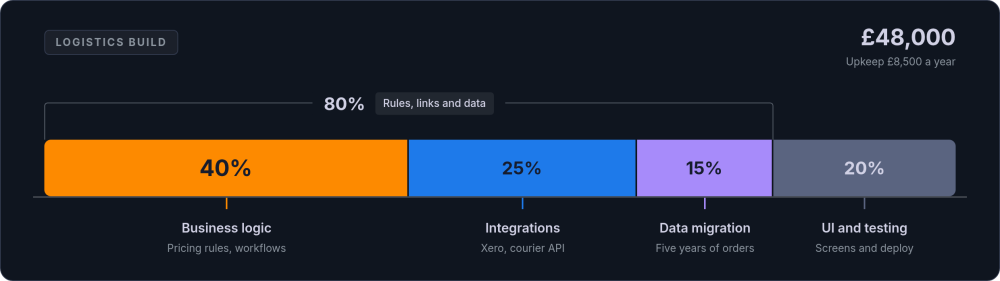
Replacing three SaaS tools with one custom platform. Typical build cost: around £48,000. Approximate breakdown: 40% business logic (pricing rules, multi-step fulfilment workflow), 25% integrations (Xero for invoicing, courier API for tracking), 15% data migration (five years of order history from two systems), 20% UI, testing, and deployment. Annual maintenance: around £8,500.
40-person professional services firm: client portal and project tracker
Consolidating spreadsheets and email-based project tracking into a single system with client-facing dashboards. Typical build cost: around £62,000. The biggest cost drivers were role-based permissions (five distinct user types) and a complex approval workflow for client deliverables. Integrations with HubSpot and Xero added four weeks to the timeline.
15-person specialist retailer: inventory and quoting tool
Replacing a spreadsheet that four people maintained (and nobody fully trusted) with a purpose-built quoting and stock management system. Typical build cost: around £18,000. Straightforward business logic and a single integration (Xero). The scope was tight, the data migration was clean, and the build took six weeks.
The pattern across all three: screen count barely registers as a cost factor. Business logic, integrations, and data migration typically account for 70 to 80% of the budget on projects like these. Real projects have more variables than any summary captures (team availability, third-party API quirks, the state of legacy data), but the proportions above reflect common patterns across the UK SMB market. When scoping a project, the productive conversation focuses on the complexity of the business rules, the number and nature of integrations, and whether data migration is involved. Everything else (screens, visual design, basic functionality) fills in around them.
Realistic Price Ranges: Custom Software Development Cost for UK SMBs
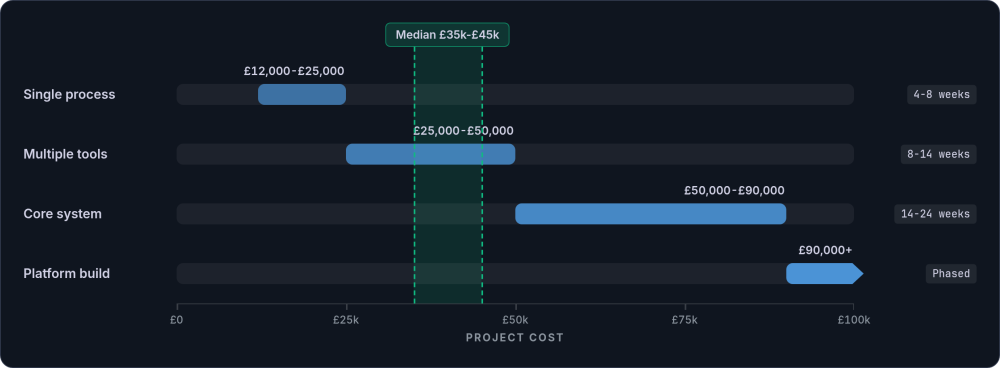
UK developer day rates for experienced professionals typically fall between £400 and £750 per day. You are paying for architecture thinking, testing, and long-term maintainability, not just typing code. Here are indicative price ranges for the kinds of bespoke software projects UK businesses with 10 to 50 employees typically need. Whether you are building a web application, an internal tool, or something closer to what people call "app development," the cost structures are broadly similar. These are not quotes, but they give you a realistic anchor for planning.
People search for the average cost of software development hoping for "one number I can take to the board." There isn't one, because averages hide the variables that matter. The honest median for a UK SMB project that does real work (consolidating tools, encoding business rules, migrating data) sits around £35,000 to £45,000. Use that as a sanity check, then place yourself in one of the brackets below.
An MVP approach can reduce the initial outlay significantly. Rather than building the complete system in one go, you identify the features that deliver the most value and build those first. A £50,000 project might start as a £20,000 MVP that proves the concept, then expand based on what you learn from real usage. This is often the most sensible way to manage both budget and risk.
Costs that catch first-time buyers off guard
Several line items routinely surprise first-time buyers. Some agencies include these in their headline price; others bill them separately. Knowing what to ask about upfront prevents the "nobody told me about this" moment.
| Cost item | Typical range | Usually in quote? |
|---|---|---|
| Data migration | £2,000 to £12,000+ | Sometimes. Often underscoped. |
| User acceptance testing (UAT) | 5 to 15% of build cost | Should be, but often missing from cheaper quotes. |
| Staff training | £500 to £3,000 | Rarely included. Usually billed as extra days. |
| Third-party API licences | £0 to £500/month | No. These are ongoing costs you pay directly. |
| Hosting and infrastructure | £100 to £300/month | Sometimes bundled, sometimes separate. |
| Security and penetration testing | £1,500 to £5,000 per test | Rarely included. Worth budgeting for annually. |
None of these are unreasonable. The issue is being caught unaware. A thorough quote addresses each item explicitly, even if the answer is "this is your responsibility." When evaluating quotes, ask about every line in the table above. If a quote is silent on data migration, UAT, or post-launch support, raise it before you sign. For a closer look at what a custom web application looks like in practice, the development section walks through the technical detail.
The Five-Year View: Custom Software vs SaaS
The initial build cost of custom software is higher than any single SaaS subscription. That much is obvious. But software cost is not a one-year calculation. Over five years, the economics often look very different, particularly for businesses running on multiple SaaS subscriptions with per-user pricing.
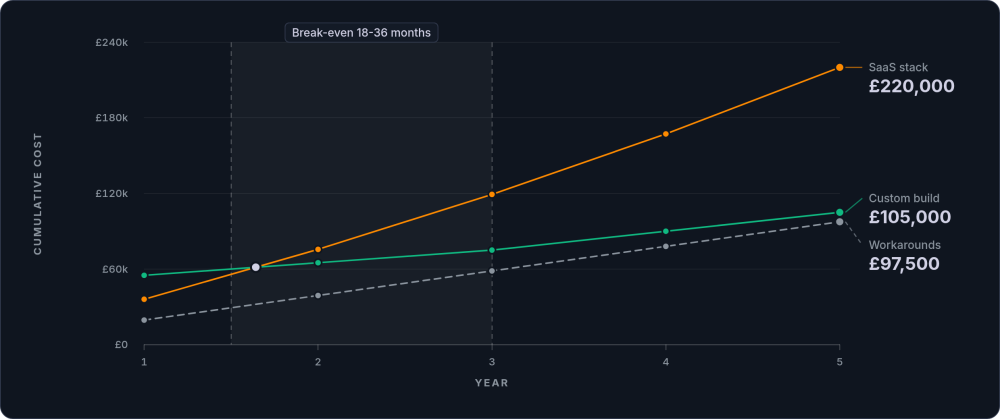
Here is how the maths typically works for a UK business with around 30 employees, using four or five SaaS tools to manage operations.
| Year | SaaS stack (cumulative) | Custom build (cumulative) |
|---|---|---|
| Year 1 | £36,000 (£3,000/month across 4-5 tools, 30 users) | £55,000 (£45,000 build + £6,000 hosting/maintenance + £4,000 initial adjustments) |
| Year 2 | £75,600 (8% price increase, 2 new users) | £65,000 (£10,000 maintenance and hosting) |
| Year 3 | £119,200 (another increase, 3 more users, add-on module) | £75,000 (£10,000 maintenance and hosting) |
| Year 4 | £167,200 (continued growth, another price rise) | £90,000 (£10,000 maintenance, £5,000 feature additions) |
| Year 5 | £220,000 (5 years of compound growth in subscriptions) | £105,000 (£10,000 maintenance, £5,000 feature additions) |
The SaaS path starts cheaper but compounds. Per-user pricing means every new hire increases the cost. Annual price rises of 5 to 15% are common across major SaaS platforms, and add-on modules that seemed optional at first become necessary as the business grows. By year three or four, the monthly bill can be double or triple what it was at the start.
The custom path has a steep year-one cost, then flattens. Maintenance and hosting are predictable. Adding users costs nothing (there is no per-seat licence). New features are built on your schedule, at your discretion, and the system becomes more valuable over time rather than more expensive.
The break-even point: For businesses replacing multiple SaaS tools, the lines typically cross between 18 and 36 months. The exact point depends on how many tools you're replacing, how many users you have, and how fast the team is growing. After that crossover, custom software is cheaper every year, and the gap widens.
Running the numbers for your own situation
The table above is illustrative. To work out whether the economics favour custom software for your business, here is a practical way to calculate it.
-
Add up your current SaaS spend Total monthly cost across all tools you would replace (not all tools, just the ones the custom system would consolidate). Multiply by 12 for annual cost. Include per-user fees, add-on modules, and any annual price increases you've already experienced.
-
Estimate your workaround cost Hours per week your team spends on manual processes the custom system would eliminate: re-keying data, reconciling spreadsheets, chasing information. Multiply weekly hours by your average fully loaded hourly rate, then by 48 working weeks.
-
Project forward five years Apply realistic growth: new hires (more per-user licences), SaaS price rises (5 to 15% annually is typical), and any add-on modules you expect to need. Compare the cumulative SaaS-plus-workaround total against a custom build estimate plus £10,000 to £15,000 annual maintenance.
-
Find your crossover year The year where cumulative custom costs fall below cumulative SaaS-plus-workaround costs is your break-even point. If it is year two or three, the investment case is strong. If it is year five or beyond, you may be better served by SaaS for now.
The cost you are already paying
The five-year comparison above only accounts for direct software spend. It does not include the cost of workarounds, which is the invisible line item most businesses never quantify. Consider a 30-person company where staff spend a collective 15 hours per week on manual processes. That includes re-keying data between systems, reconciling spreadsheets, chasing information by email, and fixing errors that automated systems would prevent. At an average fully loaded salary cost of £25 per hour, that adds up to roughly £19,500 per year in lost productivity.
Over five years, that is nearly £100,000 in workaround costs alone, on top of the SaaS subscriptions. A £45,000 custom build that eliminates even half of those workarounds pays for itself faster than the subscription comparison suggests. The real comparison is not "custom vs SaaS." It is "custom vs SaaS plus the ongoing human cost of making inadequate tools work." For businesses whose operations run through a single source of truth, those workaround hours largely disappear.
This is not an argument that custom software always wins on cost. For a three-person team using one or two SaaS tools at £50/month each, the numbers never cross. The comparison only favours custom development when the SaaS spend is significant, the business is growing, and the tools are creating friction that has its own cost. For the deeper economics of owning vs renting your systems, a dedicated guide examines the ownership question beyond pure cost.
Total Cost of Ownership: What Happens After Launch
This is the part of the cost conversation most agencies rush past. The build quote gets all the attention, but launch day is not the finish line. Software needs ongoing care, and understanding what that care involves (and costs) is essential for honest budgeting.
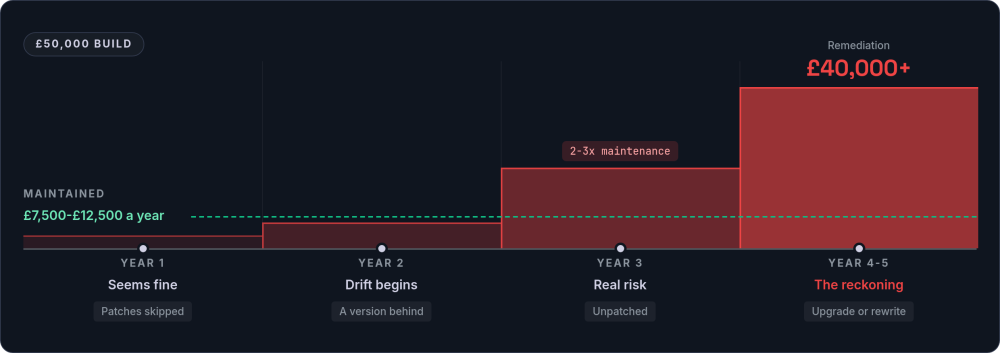
The industry rule of thumb is 15 to 25% of the initial build cost per year for maintenance. On a £50,000 build, that's £7,500 to £12,500 annually. But that figure is meaningless without understanding what it actually pays for.
-
Security patches and updates Frameworks, libraries, and server software receive regular security updates. Applying them promptly is non-negotiable.
-
Server monitoring and uptime Someone watches the logs, checks disk space, monitors performance, and responds when something goes wrong at 2am.
-
Framework and dependency updates Frameworks and supporting libraries release new versions. Keeping current means the system stays supported, secure, and compatible.
-
Minor feature adjustments Small changes based on real usage: tweaking a report format, adding a filter, adjusting a workflow step. The kind of refinements that make a good system better.
-
Support hours A pool of hours each month for answering questions, investigating issues, and providing guidance on how to use the system effectively.
Hosting costs sit alongside maintenance. For a typical UK-hosted business application, expect £100 to £300 per month depending on the scale, redundancy, and backup requirements. That covers the servers, database, SSL certificates, automated backups, and the infrastructure that keeps the application available.
Worked example: annual budget after launch on a £50,000 build.
- £6,000 to £8,000: maintenance, security patches, framework updates, and support hours
- £1,200 to £3,600: hosting and infrastructure
- £2,000 to £4,000: discretionary feature additions and refinements
- Total: £9,200 to £15,600 per year (a number you can put in a financial plan)
What happens when maintenance is deferred
Some businesses treat maintenance as optional. It isn't. Skipping maintenance doesn't save money; it defers cost and adds risk. Here is the pattern that plays out repeatedly across the industry.
That drift is gradual, which is exactly why it gets ignored. By year 3 the cost of catching up has typically grown to 2 or 3 times what a year of maintenance would have cost, and the serious consequences arrive together.
A well-maintained application can run for a decade or more. The maintenance cost is real, but it is predictable and far cheaper than the alternative. For a fuller picture of what ongoing software maintenance involves and why it matters, a dedicated guide goes into detail.
How to Structure the Investment
Spending £30,000 to £80,000 on software for the first time is a significant decision. It should feel significant. But it doesn't need to feel like a leap into the dark. The way you structure the investment determines how much risk you take on and how much control you retain.
Pricing models
Three models cover the vast majority of SMB software projects. Each has its place.
Fixed price works when the scope is well-defined and unlikely to change. You know exactly what you'll pay. The trade-off is that changes to the specification usually require a formal change request process, which adds overhead. Best suited to projects where you've done thorough discovery first and the requirements are clear.
Time and materials (T&M) works when requirements are likely to evolve. You pay for time spent, and the scope can shift as you learn. The trade-off is that you carry the budget risk: if the project takes longer, you pay more. Best suited to iterative projects (such as building complex workflow engines where the rules emerge through use) where flexibility matters more than a fixed price. A 15 to 20% contingency buffer in your budget protects against scope creep.
Retainer works for ongoing development after launch. A fixed monthly budget for continuous improvements, support, and feature additions. Predictable, flexible, and well-suited to the post-launch phase when the system is live and evolving based on real usage.
Choosing a pricing model: a practical checklist
The right model depends on where you are in the process and how well you understand the requirements.
The third model applies after launch rather than during the build, but it is worth flagging here so you can plan for it from the start. On a phased project, build work often runs as fixed price or T&M, then settles into a retainer of roughly 15 to 25% of build cost per year.
The recommended approach: phased delivery
For most first-time buyers, the smartest structure is a phased approach. It manages risk by breaking the investment into stages, each with its own deliverable and decision point.
Discovery (£2,000 to £5,000)
A short, focused engagement that produces a technical specification, a realistic budget, and a clear understanding of what you're building and why. This is the cheapest insurance you can buy. Spending £3,000 to de-risk a £50,000 decision is a straightforward calculation. At the end of discovery, you have a document you can use to compare quotes, brief other agencies, or decide not to proceed at all. Discovery phases routinely catch budget-changing surprises before a single line of code is written. One common example: a "simple" Xero integration that requires custom middleware because the API does not support the specific workflow. Another: a data migration that doubles in scope once the source data is audited properly.
MVP build (core value first)
Build the features that deliver the most value. A focused first release that your team can start using. This validates the approach with real users and real data before committing to the full scope. Typically 40 to 60% of the total budget.
Iteration (expand based on real usage)
Add features based on what you learn from using the MVP. Real usage always reveals priorities that looked different on paper. This phase is where the system becomes genuinely yours, shaped by how your team actually works rather than how you imagined they would.
This approach means you never commit the full budget upfront. Each phase ends with a working deliverable and a clear decision about whether to proceed.
When Custom Software Is the Wrong Answer
Not every business needs custom software. In some situations, building is genuinely the wrong decision, and knowing that upfront saves everyone time and money. Here are the scenarios where you should not build.
Those first two are about timing and standardisation. The next is about the market: someone may have already built exactly what you need.
The last two come down to proportion. At £18,000 to £40,000 and up, the problem has to be big enough to justify a bespoke build at all.
Being honest about these situations is practical, not idealistic. A business that builds when it shouldn't wastes money and time. A business that waits until the need is genuine builds the right thing. For the broader build-vs-buy decision framework, a dedicated guide covers this question in full.
How to Compare Agency Quotes
When you send a brief to three or four agencies, the quotes will vary wildly. The variance comes from different assumptions: one quote excludes data migration and testing, another includes discovery and three months of warranty, a third scopes a larger system than you described. They are answering different questions about the same brief. A detailed specification from a proper discovery phase (covered above) narrows the gap dramatically. Beyond the total price, here is what to look for.
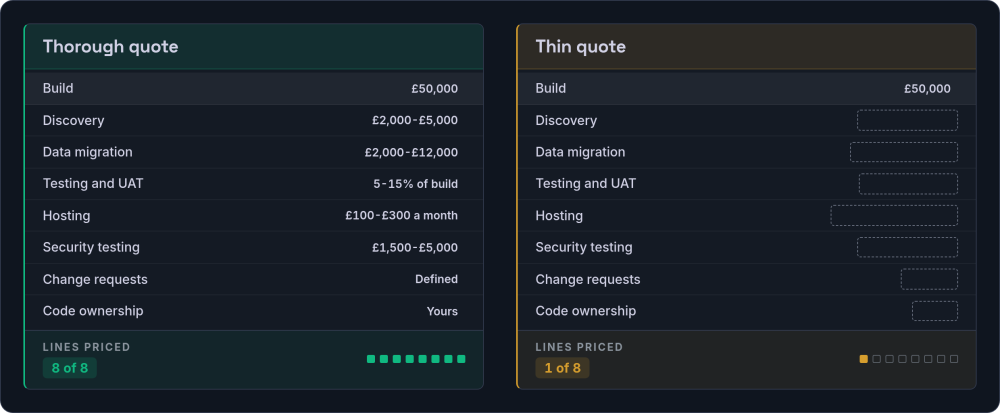
Those first two points cover the build itself. The next protects you against the "we assumed that was out of scope" conversation when the requirements shift mid-project, which they almost always do.
The final point is the one buyers forget to ask about, and the one that costs most if it goes wrong.
And the warning signs.
Those two are about what the quote leaves out. The next two are about how the work itself is run, which matters just as much once the project is under way.
UK-Specific Factors: VAT and IR35
Two UK-specific considerations affect the real cost of custom software development. Neither is widely discussed, but both are financially relevant.
VAT recoverability. If your business is VAT-registered, the VAT charged on software development services is input VAT and can be reclaimed. A £60,000 + VAT project carries a headline cost of £72,000, but the effective cost to a VAT-registered business is £60,000. This applies to development, maintenance, and hosting services. It's a straightforward 20% effective reduction on the real cost.
IR35 and engagement models. Hiring a freelance developer directly exposes your business to IR35 compliance risk and administrative overhead. HMRC's employment status rules can be complex to navigate, and getting them wrong carries penalties. Working through an established agency or consultancy simplifies the engagement. The agency handles its own compliance, and you have a clear commercial contract for services delivered. This also touches on digital sovereignty: who controls your code, your data, and the relationship with the people who build your systems.
Note: This is practical guidance, not tax advice. Confirm VAT treatment and IR35 implications with your accountant for your specific situation.
Making the Decision
If you have read this far and the numbers look plausible for your situation, the next step is not to commit to a build. It is to get enough information to make a confident decision. A discovery phase (£2,000 to £5,000) gives you a specification, a realistic budget, and a clear picture of what is involved. If the numbers do not work, you have spent a small amount to learn that. If they do, you move forward with a plan you can trust. If you would rather see something tangible before deciding, the Build Roadmap pairs that plan with a working prototype and a firm price for the build.
Your due diligence checklist
Before engaging any agency, work through these steps. They cost nothing and will sharpen your thinking considerably.
-
Quantify your current cost Total SaaS spend, workaround hours, and error correction time. If you cannot put a number on the problem, you cannot evaluate whether the investment makes sense.
-
List your integrations Every system the custom software needs to connect to. Xero, HubSpot, courier APIs, legacy databases. Each one affects the cost significantly.
-
Document your business rules The pricing logic, approval workflows, role-based permissions, and conditional processes that make your operations unique. These drive the majority of the budget.
-
Assess your data Where does your data live now, and what state is it in? Clean data in a structured database is cheap to migrate. Years of inconsistent spreadsheets are not.
-
Talk to at least three agencies Not for competing quotes (not yet), but for a conversation about approach. The right agency will ask you more questions than they answer in a first meeting. Be wary of anyone who quotes a price before understanding the problem.
Should you build?
Once you have worked through the checklist above, the decision usually falls into one of three camps. These are rules of thumb, not absolutes, but they reflect the pattern we see most often when a business is weighing up the spend.
And there is an honest third answer, the "not yet, or not at all" that most agencies will not give you because it does not lead to a sale.
From here, you might want to explore how to build operational capacity without the stress growing with it, or look at the kinds of operational systems this investment supports.
Ready to find out what it would cost for your situation?
A short conversation is enough to understand whether custom software makes sense for your business and what a realistic budget looks like.
Get in touch →