
How to Stop Being the Person Everything Depends On
There is a version of your business that runs without you in the room. Founder extraction is the work of getting there. Not because you have become irrelevant, but because your judgement has been encoded into the systems, frameworks, and decision rights that govern how things operate. The business still reflects your thinking. It just no longer needs your physical presence to act on it.
Most founders know they need to get there. Few know how. The advice they receive ("learn to delegate," "hire a manager," "trust your team") is directionally correct but practically useless. It skips the hard part: the mechanics of extracting yourself from an operation that has grown around you like scaffolding around a building.
The pattern has been named before. Michael Gerber called it the difference between working in your business and working on it. John Warrillow's Built to Sell framed it as the difference between owning a job and owning a business. The language varies. The core challenge is the same.
This page covers the practical work of founder extraction. Not the motivational poster version. The real version, where you map your decisions, build frameworks that encode your judgement, hand over authority in stages, and learn to watch the dashboard instead of standing on the factory floor.
The Founder Bottleneck Pattern
In the early years, founder involvement is a strength. You are faster than any process. Your judgement is better than any framework. Your presence is the quality control mechanism. Decisions flow through you because that is genuinely the most efficient path.
Then the business grows, and what was a strength becomes a constraint. The same personal involvement that built the company now throttles it. Decisions queue up waiting for your attention. Your inbox becomes the pacing mechanism for the entire operation.
The team stops making calls on their own because they have learned, through years of experience, that you will weigh in anyway. You become a single point of failure, and the key person risk sits entirely with you.
The founder bottleneck: A pattern where the business owner's personal involvement in decisions, approvals, and problem-solving becomes the primary constraint on operational speed, team development, and business growth. Some call it the founder's trap. In management literature, the term "founder syndrome" describes the same pattern: the paradox where the qualities that built the business are the same ones preventing it from growing further.
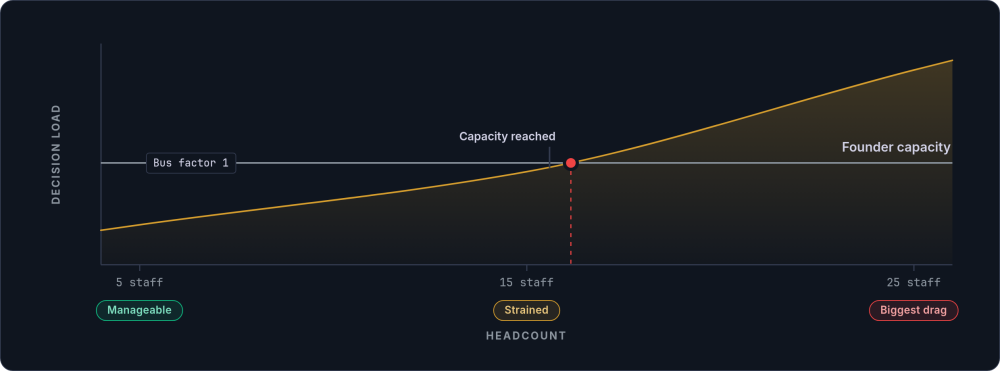
This is not a character flaw. It is a structural problem that emerges naturally in every founder-led business that grows beyond a handful of people. The founder's capacity does not scale with headcount. At five employees, personal oversight is manageable. At 15, it is strained. At 25, it is often the single biggest drag on the operation. The bus factor (the number of people who could be hit by a bus before the operation stalls) sits at one, and that one person is you. The key person dependency is total.
The costs are concrete and compounding.
If this sounds familiar, you're not alone. Almost every founder-led business between 10 and 40 people exhibits some version of this pattern. The question isn't whether you have a founder bottleneck. It's how deep the dependency runs and where to start unwinding it.
Tasks vs Decisions: The Distinction That Changes Everything
Before diving into the mechanics, it is worth drawing a line that most delegation advice blurs: the difference between delegating tasks and delegating decisions.
Delegating a task means handing someone a defined piece of work: "send this invoice," "update this report," "book this meeting." The output is prescribed. The person executing it does not need to apply judgement, only follow instructions. Most founders start here, and most find it unsatisfying. They are still the bottleneck because every task still requires their direction.
Delegating a decision is fundamentally different. It means giving someone the authority and the criteria to determine what to do, not just how to do it. "Decide whether this client gets a discount, and if so, how much" requires judgement. It requires understanding the business context, the margin implications, and the relationship dynamics. This is the kind of delegation that actually reduces founder dependency.
The real shift: Founder extraction is not about offloading your to-do list. It is about transferring decision-making authority, with clear criteria and boundaries, so the business can exercise judgement without waiting for yours. Task delegation keeps you in the loop. Decision delegation gets you out of the critical path.
The rest of this page focuses on decision delegation. How to identify which decisions to hand over. How to encode your judgement into frameworks others can follow. And how to build the organisational resilience that comes from distributed decision-making rather than centralised control.
Decision Rights Mapping: Know What You Actually Do
The first step in founder extraction is deceptively simple. Map your decision rights: catalogue every decision you currently make. Not the ones you think you make. The ones you actually make, day after day, week after week. Most founders are surprised by how many decisions they are absorbing without realising it.
Start with a two-week audit. Carry a notebook (or use a notes app) and log every decision, approval, or intervention you make. Include the small ones. The email you answered because it was easier than forwarding it. The pricing question you fielded because nobody else knows the margin thresholds. The client complaint you handled because the team did not feel authorised to offer a resolution.
After two weeks, you will have a list. It will be longer than you expected. Now categorise it. If you have used a RACI matrix before (Responsible, Accountable, Consulted, Informed), you will notice that you sit in the "Accountable" or "Responsible" column for almost everything. That is the problem made visible.
| Category | Characteristics | Action |
|---|---|---|
| High consequence, low frequency | Strategic direction, major contracts, hiring senior roles, capital allocation | Keep. These are genuinely yours. |
| Low consequence, high frequency | Routine approvals, standard pricing, scheduling, operational questions | Delegate immediately. Build decision criteria so others can handle these. |
| Medium consequence, medium frequency | Non-standard client requests, exception handling, team disputes, process changes | Build frameworks. Define thresholds and escalation criteria, then delegate progressively. |
| Should not exist | Decisions you make only because you are present, not because you are needed | Stop making these. If nobody escalated it to you, it does not need you. |
For most founders, the majority of their decisions fall into the "low consequence, high frequency" or "should not exist" categories. These are decisions that consume enormous amounts of founder time without requiring founder-level judgement. They persist not because the team cannot handle them, but because no one has ever defined the decision rights for handling them independently. Role clarity is absent. The accountability framework is implicit (which means it defaults to the founder for everything).
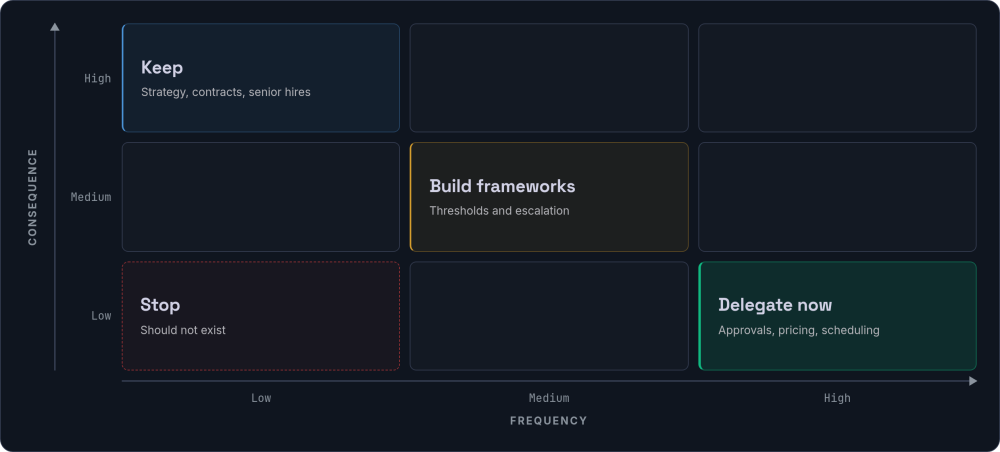
The decision rights map becomes the blueprint for everything that follows. Without it, delegation is guesswork. With it, you know exactly what to extract, in what order, and what frameworks you need to build.
Where to Start Founder Extraction: What to Systematise First
With your decision rights map in hand, the temptation is to start with the biggest, most consequential decisions. Resist that impulse. Start with the decisions that are smallest in consequence and highest in frequency. These are the ones that consume the most collective time and are the easiest to extract.
A practical priority order that works well for most businesses follows.
Routine approvals and standard responses
Pricing within established ranges, standard client queries, scheduling decisions, purchase approvals under a defined threshold. For each of these, write the criteria that determine the right answer. If the criteria are clear enough that someone else can follow them, the decision does not need you. A simple approval matrix (who can approve what, up to what value) eliminates dozens of daily interruptions. This is where a decision tree pays for itself immediately.
Client-facing processes
Onboarding new clients, handling complaints, managing scope changes, delivering status updates. These are often founder-handled because the founder cares deeply about client experience. The fix is not to care less but to encode what "good" looks like into process documentation that the team can follow consistently. Define the standard, train the team, and let them deliver it. Structured handover processes ensure nothing falls through the gaps.
Operational coordination
Resource allocation, workload balancing, deadline management, cross-team dependencies. These decisions feel complex but usually follow patterns. A project visibility system that shows capacity, deadlines, and status removes the need for the founder to be the human dashboard. The information becomes self-service. When management layers exist (even informal ones), operational coordination should sit with team leads, not with the founder.
Exception handling
Non-standard requests, edge cases, process failures. These are the last to delegate because they require genuine judgement. Build an escalation matrix: define what constitutes an exception, who handles it first, and at what point it reaches you. Most exceptions, once you categorise them, turn out to be recurring variations rather than truly novel situations. Document the resolution for each type, and the exception becomes a handled case.
Each category you extract buys you time. Not in theory, but in practice. The founder who stops handling routine approvals gains back hours each week. Those hours are not for doing more work. They are for designing better systems, thinking strategically, and doing the kind of work that only a founder can do.
Encoding Your Judgement: From Tacit Knowledge to Decision Frameworks
Every founder carries an enormous amount of tacit knowledge. The unwritten rules. The context behind pricing decisions. The instinct for which clients are likely to be difficult. The understanding of why a process works the way it does. This knowledge has never been written down, because the founder has never needed to explain it. They just do it. And this invisible dependency is what makes extraction hard.
Delegation without frameworks is abdication. The founder who says "just handle it" without providing criteria for what "handling it well" looks like is setting the team up to fail. When they inevitably make a decision the founder would not have made, trust erodes and the founder pulls the authority back. This cycle is why most delegation attempts fail.
The alternative is deliberate knowledge capture paired with decision frameworks: documented criteria that translate your judgement into a format others can apply. These are not rigid scripts. They are guardrails that define the boundaries within which the team has authority to act. The concept is similar to what the Entrepreneurial Operating System (EOS) calls "the accountability chart," though the principle applies regardless of which operating framework you follow.
A good decision framework answers four questions.
What is the decision?
Define it precisely. "Handle client complaints" is too broad. "Determine whether to offer a discount, credit, or redo when a client reports dissatisfaction with a deliverable" is actionable.
What criteria determine the right answer?
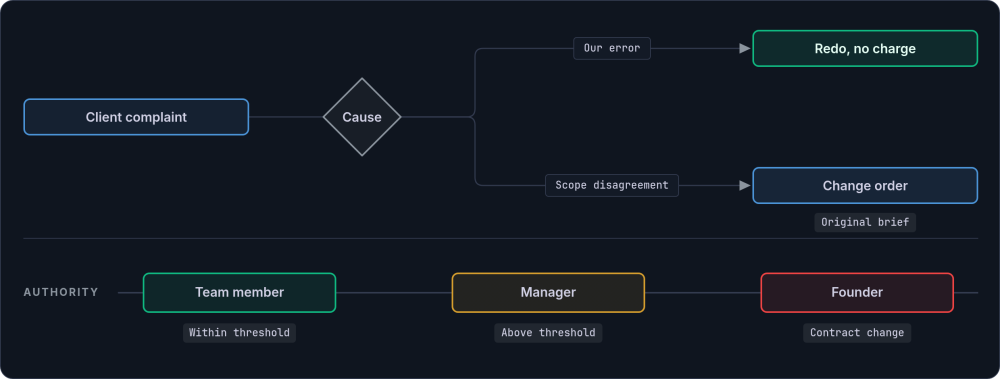
If the complaint is about a genuine error on our part, offer a redo at no charge. If it is a scope disagreement, refer to the original brief and propose a change order. If the value at risk is above a defined approval threshold, escalate.
What is the boundary of authority?
The team member can authorise discounts up to a defined percentage. Credits above that amount require manager approval. Anything involving contract changes goes to the founder. This is where role clarity matters: everyone knows their lane.
When should this escalate?
Define the triggers explicitly. Not "when it feels serious" but "when the financial impact exceeds X, when the client has escalated twice, or when the situation involves a contractual dispute." Clear escalation protocols prevent both over-escalation (which keeps the founder in the loop unnecessarily) and under-escalation (which lets problems grow).
For each framework, include the reasoning behind it, not just the rules. Record why you do not offer discounts to a particular client segment. The history behind a pricing structure. The lesson learned from a project that went wrong three years ago. This institutional memory is what prevents the team from repeating mistakes the founder already learned from. Without it, every new team member starts from zero.
These frameworks take time to build. A founder working through this process for the first time will typically spend two to three weeks documenting the frameworks for their most common decisions. It feels slow. It is also the highest-value work you will do that quarter, because every framework you complete is a permanent extraction. That decision largely stops requiring your involvement.
The frameworks live in your operational systems, not in a document that nobody reads. Process automation can enforce approval thresholds, route escalations, and log decisions for review. The system becomes the carrier of your judgement. Building that layer is what a business automation project delivers: the approvals, routing, and record-keeping handled by software instead of by you. Tools like Notion, Confluence, or even a well-structured shared drive can house this documentation. The tool matters less than the habit of capturing it.
Progressive Delegation and Team Capability
Extraction does not happen in a single handover. It happens in stages, and rushing it is one of the most common mistakes. The founder who dumps a category of decisions on an unprepared team and then watches things go wrong will conclude that delegation does not work. It does work. It just works in stages, and the team develops capability through the process itself, not before it.
The progression follows a predictable path.
Shadow
Team member observes the founder making decisions and understands the reasoning
Advise
Team member recommends a decision; founder reviews and approves
Decide and report
Team member makes the call and informs the founder after the fact
Own
Team member has full authority; founder sees outcomes in reporting only
Each stage is a test. If the team member's recommendations consistently align with what the founder would have decided, they're ready to move to the next stage. If there are gaps, those gaps reveal where the decision framework needs more detail, not where the team member has failed.
In founder-led businesses, teams often develop a form of learned helplessness: a pattern where capable people stop exercising judgement because they have been conditioned to defer upward. The founder answers every question, so the team stops trying to answer questions themselves. This is not a reflection of their ability. It is a reflection of the environment they have been operating in.
Reversing learned helplessness requires deliberate effort on three fronts.
-
Clear decision frameworks Covered above. Without criteria, people defer because they genuinely do not know what answer you would give. The framework removes the guesswork.
-
Visible authority Publish who owns what decisions. If the delegation is only in the founder's head, the rest of the organisation will keep routing decisions upward. A simple "decision rights" document, shared with the team and referenced regularly, makes the authority real rather than theoretical.
-
Calibration feedback loops When team members make decisions, review a sample regularly. Not to overrule them, but to sharpen their judgement over time. "Here is what I would have done differently, and here is why" is coaching, not correction. Jurgen Appelo's Management 3.0 framework calls a version of this "Delegation Poker," where teams explicitly negotiate the level of authority for different decision types. The principle is the same regardless of the framework you use: make the boundaries visible and adjust them as capability grows.
The timeline varies by decision type. Routine approvals might move through all four stages in a month. Complex client relationship decisions might take six months. Strategic planning decisions might never fully extract. That is fine. The goal is not to remove the founder from everything. It is to remove them from everything that does not genuinely require them.
One practical technique accelerates the process. When a team member brings you a decision, ask them what they would do before you give your answer. If their instinct aligns with yours, tell them so and let them proceed. If it does not, explain the gap. Over time, this trains the team to think a decision through before escalating it. It also trains you to notice when their judgement has developed to the point where your involvement is no longer needed. The team gets better at making decisions by making decisions. Your job is to create the conditions where they can do so safely.
The Psychology of Letting Go
The practical mechanics of extraction are the easier half. The harder half is emotional. Most founders who struggle with delegation are not struggling because they lack frameworks or capable team members. They are struggling because their identity is intertwined with being the person who does the work, makes the calls, and holds things together.
| What the founder feels | What it sounds like | What is actually true |
|---|---|---|
| Control anxiety | "Nobody does it the way I would" | Different is not worse. Define what "good enough" looks like and accept that 90% of your standard, delivered consistently by a team, beats 100% of your standard delivered by you alone at half the speed. |
| Identity attachment | "This business is me" | A business that depends on you is not a business. It is a job with worse hours. Your value shifts from doing the work to designing the system that does the work. |
| Perfectionism | "I need to check everything" | Checking everything guarantees that nothing moves quickly. Spot-checking and exception-based review give you quality assurance without becoming the bottleneck. |
| Fear of irrelevance | "If they don't need me, what am I for?" | The founder's role evolves. The business needs your vision, relationships, and strategic thinking more than it needs you approving purchase orders. |
None of this is weakness. It's the natural consequence of having built something from nothing with your own effort and judgement. The founders who extract most successfully tend to reframe the process: they aren't making themselves unnecessary. They're making the business capable of reflecting their standards without requiring their constant presence. Strategic Coach calls this your "unique ability": the highest-value contribution that only you can make. Everything else should sit with someone else.
Monitoring Without Micromanaging
The most common objection to extraction is the fear of losing visibility. The answer is not "trust your team" (though that matters). The answer is building visibility systems that give you oversight without requiring involvement. Involvement means you are in the loop for every decision. Oversight means you can see the outcomes, spot the exceptions, and intervene only when the data tells you something needs your attention.
A well-designed operational dashboard shows the state of the business in real time: project progress, client health, financial metrics, team capacity. If you need to call a meeting to find out what is happening, your visibility system is not working. A good dashboard should make most status meetings unnecessary. Pair that with exception-based alerts (a project over budget by more than 15%, a client satisfaction score that has dropped, a workload spike beyond capacity) and you have a system that watches for you. You act only when something is genuinely off. A purpose-built dashboard is usually the fastest way to get that view in place.
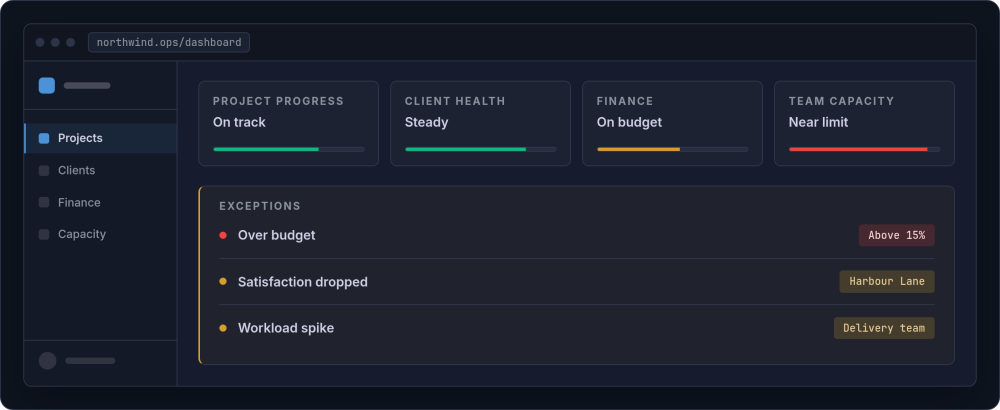
Schedule a weekly or fortnightly review of delegated decisions. Not to second-guess them, but to calibrate. Check whether the frameworks are producing the right outcomes and whether patterns in the exceptions suggest a framework needs updating. This is quality assurance, not micromanagement. The goal of any project visibility system is exactly this: giving you the information you need to feel confident without requiring you to be personally involved in the flow of work.
Founder Extraction and Business Valuation
There is a financial dimension to this that many founders underappreciate. A business where the founder is the operating system is worth less than one where the founder is an investor with strategic oversight. Acquirers, investors, and business brokers all assess owner dependency as a core risk factor. If you are building toward management buyout readiness or any kind of exit, extraction is not optional.
The valuation reality: Businesses with high owner dependency typically sell at lower multiples than those with documented operations and delegated decision-making. The gap can be significant. An acquirer is not buying your personal involvement. They are buying a system that generates value independently. As Warrillow argues in Built to Sell, a business that cannot run without you is a business that nobody else wants to buy.
Even if you have no plans to sell, the exercise of making your business sellable makes it better to run. A business that can operate without you also gives you choices. The choice to step back, to focus on growth, to take a sabbatical, or simply to finish work at a reasonable hour.
The connection to vertical integration is direct. A vertically integrated system, where data flows from sales through delivery to invoicing without manual intervention, is inherently less founder-dependent. The system carries the process, not the person. When you invest in automating your core business processes, you are simultaneously increasing operational efficiency and reducing owner dependency. The result is greater organisational resilience: the business absorbs disruption (including the founder's absence) without breaking stride.
What Founder Extraction Looks Like in Practice
Founder extraction is not a single project. It is a sustained effort that typically takes 12 to 24 months for a business of 15 to 40 people. The work happens in layers, and each layer frees up more founder time and builds more team capability.
Here is what the progression typically looks like.
| Timeline | Before | After extraction work |
|---|---|---|
| Month 1 to 3 | Founder handles routine approvals, client queries, and scheduling personally | Approval matrices and decision criteria documented. Team handles routine decisions independently. |
| Month 3 to 6 | Client relationships run through the founder. Status updates require asking around. | Client processes documented. Visibility dashboards replace status meetings. Team owns client communication. |
| Month 6 to 12 | Operational decisions (pricing, resource allocation, exception handling) all route through the founder | Decision frameworks with clear escalation criteria. Team leads have defined authority. Founder reviews exceptions only. |
| Month 12 to 24 | The founder is the strategy, the operations, and the quality control rolled into one | The founder focuses on strategy, key relationships, and periodic review. The business operates on systems, not on the founder's diary. |
The timeline is not fixed. Some businesses move faster because they already have capable team members waiting for authority. Others take longer because the founder's tacit knowledge runs deep and the process documentation work is substantial. Both are normal.
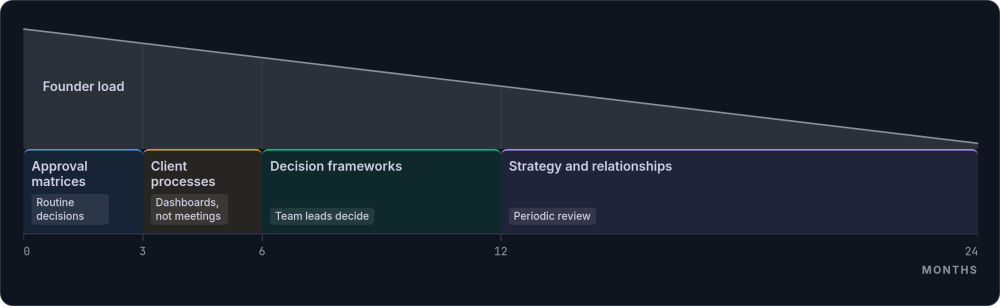
What matters is the direction. Each month, the founder should be involved in fewer operational decisions than the month before. If that trend reverses, something in the system needs attention: a framework that is not working, a team member who needs more support, or an escalation protocol that is too loose.
Practical Knowledge Capture: Getting It Out of Your Head
Decision frameworks are only as good as the knowledge behind them. And most of that knowledge lives in your head, unwritten and invisible. The pricing logic you apply instinctively. The warning signs you recognise in client behaviour because you have seen them before. The reason a process works the way it does, rooted in a failure from four years ago that nobody else remembers. This is tacit knowledge, and extracting it is one of the hardest parts of the whole process.
The challenge is that tacit knowledge resists documentation. Ask a founder to "write down how you make pricing decisions" and you will get a blank stare or a paragraph that captures about 20% of what they actually do. The rest is pattern recognition, context, and accumulated experience that does not translate easily into bullet points.
There are several practical methods that work, and the best approach usually combines more than one.
Narrated walkthroughs
Record yourself (using Loom, a screen recorder, or even a voice memo) as you work through a real decision. Talk through your reasoning out loud: "I am looking at this proposal and my first instinct is to push back on the timeline because..." The narration captures the thought process, not just the outcome. Someone else can then distil it into a written framework. This works particularly well for complex judgement calls where the decision criteria are hard to articulate in the abstract.
Reverse engineering past decisions
Pick ten recent decisions you made in a particular category. For each one, write down what you decided, what factors you weighed, and what would have changed your answer. Patterns emerge quickly. You will notice that you always consider the same three or four variables, that certain thresholds trigger different responses, and that some factors you thought were important actually do not influence your decisions at all. Those patterns become the bones of the framework.
Apprentice questioning
Have someone shadow you for a week and ask why you did that after every decision. Not challenging, just curious. A good operations manager or team lead can do this. The questions force you to articulate reasoning you normally skip. Record the answers. This method is slower, but it catches the decisions you make so automatically that you would never think to document them. It surfaces the invisible choices.
Exception journals
For one month, every time a situation arises that does not fit your existing processes, write a brief note: what happened, how you handled it, and why. Exceptions reveal the edges of your current documentation. They show where your tacit knowledge is still doing the work that a framework should be doing. After a month, you will have a list of the most common exceptions, and each one becomes a candidate for a new decision rule or an update to an existing framework.
Tools like Trainual, SweetProcess, or even a well-organised Notion workspace can house the results. The tool matters far less than the habit. What matters is that the knowledge moves from being resident in one person to being accessible to anyone who needs it. This is the foundation of institutional memory: the collective understanding that allows a business to learn from its own history rather than repeating the same lessons with every new hire. A deliberate knowledge management system is how that understanding stops living in one person's head.
One warning: do not attempt to document everything at once. Start with the decisions you are actively trying to delegate. Capture the knowledge behind those first, build the frameworks, hand them over, and then move to the next category. Trying to write the complete operating manual for your business in one pass is a project that never finishes. Sequential, decision-driven documentation actually gets done.
Common Extraction Failures and How to Recover
Extraction attempts fail more often than they succeed, and the failure modes are predictable enough that they are worth naming explicitly. Knowing what tends to go wrong makes it easier to spot early and correct before the whole effort stalls.
The delegation snap-back
The founder delegates a category of decisions, the team makes a call the founder disagrees with, and the founder pulls the authority back. This is the most common failure mode. It usually happens because the decision framework was too vague (leaving room for misalignment) or because the founder did not explicitly define what "good enough" looks like. The fix is not to reclaim the authority. It is to tighten the framework: add the missing criteria, clarify the boundary, and re-delegate with better guardrails. Every snap-back is a sign that the framework needs work, not that delegation does not work.
Delegation without authority
The founder tells someone they own a decision, but the rest of the organisation still routes that decision to the founder. This happens when the delegation is private rather than published. If the team does not know that Sarah now owns client complaint resolution, they will keep emailing the founder. The fix is visibility: publish the decision rights map, tell clients who their point of contact is, and actively redirect decisions that come to you back to the person who owns them. This feels awkward at first. It is necessary.
Abdication disguised as delegation
The founder, exhausted from years of doing everything, dumps an entire area of responsibility onto someone without frameworks, context, or support. This is not delegation. It is abdication, and it almost always ends badly. The team member flounders, makes mistakes they did not have the context to avoid, and both parties conclude that "the team is not ready." The reality is that the handover was not ready. Delegation requires investment upfront: build the framework, transfer the knowledge, shadow the first few decisions, and then step back progressively.
The perfection trap
The founder waits until the team can make decisions at 100% of the founder's quality before letting go. This moment never arrives, because the team develops judgement by making decisions, not by waiting for permission. The standard to aim for is "good enough, consistently." If the team makes decisions at 85% of your quality but makes them three times faster and without requiring your involvement, the business is better off. Perfect is the enemy of extracted.
Extracting the wrong things first
Some founders start by trying to delegate their most complex, high-stakes decisions. These are the hardest to extract and the most likely to go wrong early, which kills confidence in the whole process. Start with the boring stuff. Routine approvals, standard responses, scheduling decisions. These are low-risk, high-frequency, and their successful delegation builds momentum and trust for harder extractions later. Think of it as the Theory of Constraints applied to your own role: find the easiest bottleneck to remove first, not the biggest.
Recovery from a failed extraction attempt is always possible, but it requires honesty about what actually went wrong. In most cases, the failure sits with the process, not the people. The framework was incomplete, the authority was unclear, or the handover was too abrupt. Diagnose the root cause, fix the system, and try again. The founders who eventually succeed are not the ones who get it right the first time. They are the ones who treat each failure as feedback and adjust.
The Outcome: Calm, Freedom, Headspace
Founder extraction is not about diminishing your role. It is about elevating it. The founder who has successfully extracted from operations is not less important. They are more effective. Their time goes to the work that only they can do: setting direction, building relationships, making the strategic calls that shape the business's future.
The practical difference is felt daily.
-
The business runs while you are away Holidays become actual holidays. The team handles the week without a queue of decisions waiting for your return.
-
Decisions happen at the speed of the team, not the speed of the founder Clients get faster responses. Projects move without waiting for one person's bandwidth.
-
Your team develops genuine capability People who are trusted to make decisions become better decision-makers. The team grows because you gave them room to.
-
The business becomes a transferable asset Whether you plan to sell or not, a business that operates independently is worth more and gives you more options.
-
You get your headspace back The mental load of being the person everything depends on is enormous. Extraction gives you the cognitive freedom to think about where the business is going, not just what it is doing today.
This is what it adds up to: a business that gives you calm, freedom, and room to think. Not a business that traps you in the middle of every operational detail. The systems and frameworks described on this page are all buildable. The question is whether you are ready to start.
Want to talk this through?
If you are working through founder extraction and want a second perspective on where to start, we are happy to have that conversation.
Get in touch →